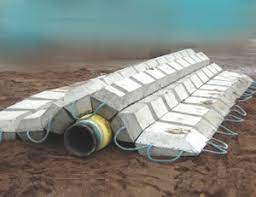
Concrete Armour Mats and Geotextile Sand Bags are practical solutions for erosion control, bank stabilization, shoreline protection, and marine construction. These systems are designed to provide protective layers or barriers in areas exposed to soil movement, water flow, wave action, and coastal erosion.
What Are Concrete Armour Mats?
Concrete Armour Mats are flexible geotextile systems designed to contain concrete and create a protective surface over suitable areas. Geotextile grout bags and concrete mattresses are manufactured from double-layer, high-strength polyester and polyamide fabrics.
Available in different sizes, the mattresses incorporate filling vents that simplify installation and concrete placement. Concrete is poured through the vents, while excess water escapes through the pores of the fabric. The concrete remains contained inside the mattress and cures to create a protective armour layer.
How Concrete Armour Mats Work
The installation process generally involves:
Preparing and positioning the mattress over the required area.
Securing the mattress according to the project design.
Filling the mattress with concrete through the designated vents.
Allowing excess water to escape through the geotextile pores.
Retaining the concrete within the fabric structure.
Allowing the concrete to cure and form the protective surface.
This flexible formwork system can conform to suitable ground contours while providing concrete-based erosion protection.
Applications of Concrete Armour Mats
Concrete Armour Mats can be considered for a variety of civil engineering, water-management, and marine applications, including:
Embankment protection
Bank stabilization
Slope stabilization
Canal protection
Reservoir protection
Dam protection
Shoreline protection
Coastal erosion control
Underwater pipeline protection
Pipeline ballast
Underwater concrete formwork
The appropriate system should be selected according to site conditions, hydraulic forces, soil characteristics, slope geometry, and project requirements.
Geotextile Sand Bags for Shoreline Armoring
Geotextile Sand Bags are high-strength fabric containers designed to be filled with sand or other suitable materials. They can provide a cost-effective option for shoreline armoring in appropriate applications.
Filled bags can be stacked on top of one another to form protective structures that help reduce the effects of coastal erosion. Their flexible construction allows them to adapt to suitable shoreline contours.
What Are Geotextiles?
Geotextiles are permeable fabrics commonly manufactured from polypropylene or polyester. They can provide several functions, including:
Filtration
Separation
Protection
Selective drainage
Soil reinforcement
These properties have made geotextile products useful in construction, marine, petrochemical, and quarrying sectors.
They are widely used in applications involving embankments, retaining structures, reservoirs, canals, dams, bank protection, and coastal protection.
Concrete Armour Mats for Bank and Slope Protection
Banks and slopes can experience erosion from flowing water, rainfall, wave action, and other environmental forces. A properly designed Concrete Armour Mat can provide a protective surface over suitable areas.
The flexible geotextile structure allows concrete to be placed in a controlled configuration while following appropriate surface contours.
Site conditions should be evaluated before installation, including slope geometry, drainage, soil characteristics, water velocity, and expected hydraulic forces.
Underwater Pipeline Protection and Ballast
Geotextile grout bags and concrete mattresses can also be used for protection and ballast of underwater pipelines.
When properly designed, a concrete-filled mattress can add weight and provide physical protection around suitable subsea pipeline installations. Mattress dimensions, weight, placement, and anchoring should be determined according to project-specific engineering requirements.
Flexible Formwork for Underwater Concrete
Concrete Armour Mats can also function as flexible formwork for underwater cementitious material injection.
Concrete is introduced through the filling vents, while excess water can escape through the geotextile pores. The fabric retains the concrete as it cures, producing a protective structure for suitable underwater stabilization and erosion-control applications.
Concrete Armour Mats vs. Geotextile Sand Bags
Feature Concrete Armour Mats Geotextile Sand Bags
Filling Material Concrete Sand or suitable fill
Primary Function Surface erosion protection Shoreline/barrier protection
Construction Flexible geotextile mattress High-strength fabric container
Typical Applications Banks, slopes, canals, pipelines Shorelines, banks, coastal areas
Final Structure Cured concrete protective layer Filled protective barrier
Installation Filled through vents Filled and positioned
The best solution depends on the project's erosion-control objectives, environmental conditions, hydraulic forces, and engineering requirements.
Benefits of Concrete Armour Mats
For suitable applications, Concrete Armour Mats can offer:
Flexible surface protection
Erosion-control capabilities
Bank and slope stabilization
Adaptability to suitable contours
Underwater protection applications
Pipeline protection and ballast
Concrete containment through geotextile formwork
Practical filling through integrated vents
Selecting the Right Erosion-Control Solution
Choosing between Concrete Armour Mats, geotextile grout bags, concrete mattresses, and Geotextile Sand Bags requires consideration of the project's specific conditions.
Important factors include water flow, wave action, soil characteristics, slope angle, expected erosion forces, drainage, installation access, loading conditions, and required service life.
For major marine, coastal, hydraulic, or infrastructure projects, professional engineering assessment is recommended to determine appropriate product specifications and installation methods.
Concrete Armour Mats and Geotextile Sand Bags for Erosion Protection